Proactive Non-Human Identity Security vs. Reactive Detection

Share


Seeing everything means nothing if you can’t act on it.
Security teams have made enormous progress in discovering and gaining visibility into non-human identities (NHIs). In the past few years, a wave of new tools has helped IAM and security teams uncover service accounts, API keys, tokens, and other machine identities that were previously invisible. Teams can now view this information in a variety of ways, such as graphs that show the dependencies and interconnections between points.
That visibility matters. Knowing which identities exist and where risks hide is a critical first step toward securing modern infrastructure. But visibility alone doesn’t reduce risk. When it comes to non-human identity security, detection without control still leaves organizations exposed.
Non-human or machine identities (and certainly AI agents) don’t behave like human users. They run continuously, operate autonomously, and often hold persistent privileges across cloud, SaaS, and internal systems. When something goes wrong, the blast radius can be immediate and massive.
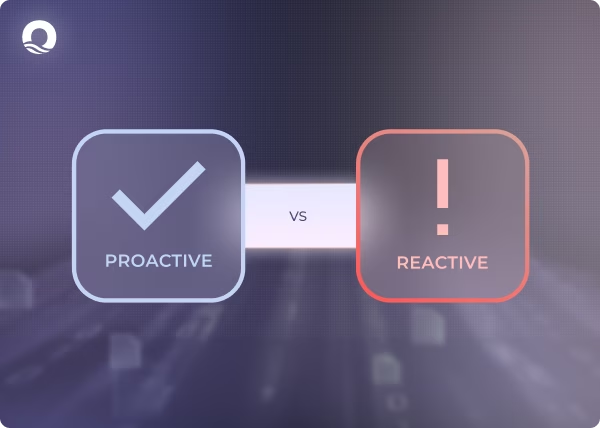
That’s why the most important shift in identity security today isn’t better visibility. It’s moving from reactive detection to proactive lifecycle control for non-human identities.
What Is Reactive Non-Human Identity Security?
Reactive identity security focuses on detecting abnormal behavior after identities have already been deployed and are operating. In practice, most reactive approaches attempt to identify compromised or misused credentials by monitoring behavior and alerting on deviations.
A reactive model typically works like this:
- Discover identities and credentials
- Observe how they behave over time
- Build a “normal” baseline
- Alert or react when behavior deviates
These capabilities are useful, but they are inherently backward-looking. They tell you something is wrong after the risk already exists. The problem is simple: attackers don’t have to deviate from the baseline to cause damage. If a compromised credential already has legitimate access, an attacker can often operate within expected patterns. And by the time a deviation appears, the damage may already be done.
Why Reactive Identity Security Fails for Machine Identities
Reactive controls struggle when it comes to machine identities because these identities already operate with automated access across systems. Unlike human users, non-human identities often operate continuously and at machine speed, which means attacks can occur within seemingly normal-looking behavior.
When attackers gain access to valid credentials, they often don’t trigger detection systems. Instead, they simply use legitimate permissions exactly as designed. This is why reactive monitoring alone cannot fully secure service accounts, service principals, tokens and secrets, API keys, and certainly not AI agents.
Where Reactive Controls Break Down
There are several common scenarios where waiting for anomalies or incidents to occur, in order to react, is simply too late.
1. Credential exposure
Secrets leak constantly, through code repositories, build logs, collaboration tools, or misconfigured storage. Detection tools can often identify exposed credentials and trigger rotation quickly once they’re found. But that still leaves a critical gap: exposure often goes undetected for days, weeks, or longer.
If a long-lived credential is compromised and not immediately discovered, an attacker can access systems without triggering any anomaly detection. The real risk isn’t just exposure; it’s how long that credential remains valid after exposure.
Proactive lifecycle controls reduce this risk by:
- Automatically rotating credentials on a regular basis
- Adding identity context to secrets
- Shortening credential lifetimes
- Decommissioning unused identities
This limits the window in which stolen credentials remain usable—even if exposure is discovered late or not at all.
2. Orphaned machine identities
In many organizations, thousands of service accounts outlive the systems or developers that created them. Without proactive lifecycle management, combined with context enrichment, these identities quietly accumulate permissions and remain active long after they are needed.
The result:
- Orphaned accounts with privileged access
- Credentials that are never rotated
- Identities that no one owns or monitors
A reactive model may detect misuse eventually, but proactive governance prevents these risks from existing in the first place by identifying stale identities and automatically decommissioning them.
3. Cloud-native and dynamic infrastructure
Modern infrastructure is highly dynamic. Workloads move across environments. Containers spin up and down. SaaS APIs are accessed from constantly changing locations and services. In cloud-native environments, change is constant, so “normal behavior” stops being a reliable security signal.
This creates a fundamental problem for reactive security: there is no stable baseline to detect deviations from. When identities operate across rapidly changing environments, behavior that looks unusual one moment may be completely legitimate the next.
That forces detection systems into a tradeoff:
- Be strict and generate noise and false positives
- Be flexible and allow risky behavior to go unnoticed
In both cases, attackers can operate within what appears to be normal activity. Instead of relying on behavioral baselines, organizations need identity controls that are policy-driven and lifecycle-aware, governing how machine identities are created, used, and retired regardless of where they run. Instead of waiting for deviations, organizations need identity controls that are policy-driven and lifecycle-aware, governing how machine identities are created, used, and retired.
4. Autonomous AI agents
The rise of AI agents adds another layer of urgency to non-human identity security. AI systems increasingly act on behalf of users and applications—calling APIs, executing workflows, authenticating and interacting with multiple systems autonomously.
These agents often operate at machine speed with persistent credentials. Waiting for anomalous behavior before acting is risky when:
- AI agents may execute thousands of actions per minute
- Privileges span multiple systems
- Automated workflows can amplify mistakes quickly
Proactive governance ensures these identities are controlled before they begin operating.
What Is Proactive Non-Human Identity Governance?
Proactive identity governance focuses on controlling the lifecycle of machine identities before risk emerges. Instead of relying only on detection, organizations establish policies and automation that manage identities from creation to retirement.
A proactive lifecycle model includes:
- Discovering all machine identities across cloud, SaaS, on-prem, and infrastructure
- Building rich integrations across your environment and ensuring representation of usage or consumers to provide critical context
- Provisioning all new NHIs and agents from day one with automated workflows for transferring ownership and decommissioning unused accounts
- Assigning ownership and ensuring human accountability for NHIs, making recommendations where this doesn’t exist, and helping organizations measure and report on their progress
- Continuously analyzing usage and permissions and right-sizing to ensure least privilege
- Automatically and safely rotating credentials to reduce long-lived credentials, respond to exposures and vulnerabilities, and help prevent outages
- Enforcing access policies before access is abused and establishing protective guardrails that prevent common risk scenarios
- Decommissioning unused, stale identities and agent access at scale without limiting operational efficiency
This lifecycle approach ensures identities remain controlled throughout their existence, not just when they trigger alerts.
Visibility vs. Control in Identity Security
Discovery, mapping, and monitoring are essential building blocks for identity security. But visibility alone is not the end goal and doesn’t inherently reduce risk.
Security teams don’t reduce risk by observing identities. They reduce risk by governing them throughout their lifecycle. That means moving beyond reactive detection toward proactive lifecycle control—especially as organizations rely more heavily on machine identities and autonomous AI systems.
Why Proactive Identity Security Matters for the Future
As infrastructure becomes more automated, identity security must evolve with it. NHIs already outnumber human users in most environments. AI agents will accelerate that trend dramatically. Organizations that rely solely on visibility and anomaly detection will always be one step behind. The organizations that succeed will adopt a proactive model, one in which identities are continuously governed, automatically maintained, and actively controlled throughout their lifecycles.
We do newsletters, too
Discover tips, technical guides and best practices in our biweekly newsletter.


