The Posture Trap: Why Identity Findings Don't Turn Into Fixes


Share


Ask any identity team what’s blocking their non-human identities (NHIs) and AI agent governance program and you’ll hear the same answer in different words: we can’t prove it’s safe to act. Not “we can’t find the risk.” Not “we don’t have the tools.” Not “leadership doesn’t care.” The blocker is confidence.
Posture tools can tell you what exists and what looks risky. But they rarely give you the operational evidence you need to intervene without taking production down: what the identity is supposed to do, what actually depends on it, where real behavior diverges from policy, who gets paged if it breaks, and what the blast radius will be if you rotate, remove access or right-size permissions.
That’s the posture trap: visibility without enforceability. You can inventory every NHI and AI agent and their associated secrets… and still be unable to manage even one with certainty.
This piece is about that missing layer between discovery and enforcement, the part that turns a finding into a decision you can execute confidently.
Posture is the gap. Management is the closure.
Posture tools are great at answering: What exists? What permissions does it have? What looks risky?
But when you try to remediate, the questions that matter are different: What is this identity supposed to do? Who will get paged if I touch it? What will break if I rotate, revoke, or remove it? What is our policy, and are we following it? For agents: what intent is this access path enabling?
This is where remediation dies. Because most teams are governing identity risk the same way they govern everything else: issue-based governance. Open a ticket. Assign it to someone. Ask for approval. Hope nothing breaks. Repeat.
That model collapses at a non-human scale, and it breaks faster in the age of AI agents, where access pathways multiply and change shape quickly. The backlog grows faster than your ability to triage it. Reviews become rubber stamps. And every "fix" feels like a one-off incident response. The problem isn't a lack of findings. It's a lack of confidence.
Why policy vs. behavior is the gap you can’t ignore
Most organizations already have identity policy: rotation standards, ownership requirements, least-privilege expectations, rules for vendor access, rules for production, and rules for exceptions. Increasingly, rules for what AI agents can and can't access.
But policy usually lives in documents and spreadsheets—while the environment evolves on its own.
That mismatch (between what you say is true and what's actually happening) is where risk lives. And it's exactly why posture doesn't become action.
Posture can show you what looks risky. The harder question is: risky relative to what you meant to enforce, and what will happen if you change it?
Consider the difference between these two findings:
- Finding A: "This service account hasn't authenticated in 90 days."
- Finding B: "This service account hasn't authenticated in 90 days. Your organization's policy requires decommissioning after 60 days of inactivity. The account holds privileged access to your production Salesforce instance. It was created by an employee who left the company in Q3. No active workload depends on it."
Finding A creates debate. Finding B creates action. The difference between them is policy intelligence.
The missing bridge: What is NHI policy intelligence?
Policy intelligence is the layer between discovery and lifecycle enforcement. It's the practice of continuously comparing what your organization says should be true about its non-human and agentic access against what is actually true, while adding the context required to act with confidence.
With AI agents, it becomes even more important because access is increasingly intent-based: governance isn’t only “what can this identity access,” but “what is this agent trying to do, through which access path, and is that aligned with policy?”
Policy Intelligence bridges the gap in three specific ways:
1. It makes policy real across a fragmented stack
In a fragmented environment, “standard rotation” looks different in AWS than it does in Snowflake or GitHub. Many tools can show policy violations in one place; the harder challenge is defining and maintaining a coherent standard across all places, without pretending every NHI should be treated the same.
Policy intelligence provides a single source of truth for defining, tracking, and evaluating policy end-to-end, while staying flexible enough to adapt to different NHI categories and risk tiers (e.g., a critical production integration vs. a dev-sandbox service account). The output isn’t “here are 8,000 identities.” It’s “here are the identities that drift from the standards you set, and the exact rule they violate.”
2. It adds the context that turns drift into confident action.
This is where most programs stall. To remediate, you don’t just need to know something is “non-compliant.” You need to know what will happen if you fix it.
Policy intelligence pulls in the missing context: purpose, ownership, dependency signals, observed usage patterns, and blast radius. That context does two things at once:
- Prioritization: you stop treating every finding as urgent and focus on what can cause real damage.
- Confidence: you can rotate, revoke, right-size, or decommission without guessing.
A concrete example: a service account used only for month-end close may authenticate once every 30–31 days and write to a production finance system. A snapshot can label it “inactive.” Context shows it’s rare but business-critical, so the right move is controlled rotation and ownership remediation, not blind decommissioning. Meanwhile, identities with zero signals across a meaningful window become high-confidence enforcement candidates.
3. It replaces “Ticket-Ops” with repeatable lifecycle enforcement.
Most governance models collapse because they just open more Jira tickets. Issue-based governance treats the symptom (one stale account) and delegates the risk to someone else.
Policy intelligence enables action playbooks that address root causes: ownership, purpose, permissions, rotation, exceptions, not just one-off fixes. Instead of asking a human to review a list of 500 identities, you define the policy and the confidence threshold (e.g., “If an NHI is unowned and inactive for 90 days with no dependency signals, disable it”) and let the system enforce it consistently.
Why this changes everything for practitioners
If you run identity, you don't need more alerts. You need fewer debates.
Policy intelligence shifts the conversation from opinion to proof: "Here's the policy." "Here's where reality deviates." "Here's the blast radius." "Here's the enforcement candidate list, ranked by confidence." That's how you move from whack-a-mole to lifecycle.
This is also what changes the operational dynamic described in our guide to NHI management: audits don't fail because teams don't care, they fail because teams can't connect what uses the identity, what it can access, and what it actually does. Policy intelligence provides that connective tissue, turning certification from a fear-based guess into an evidence-based decision.
Where lifecycle enforcement becomes real: decommissioning as the proof point
Decommissioning is the perfect test case because it exposes the trap most clearly. Most teams want to remove orphaned identities. They just can't prove they're safe to remove. The blockers are always the same: "We don't know what uses it." "We don't know who owns it." "We don't know what will break." "We'll do it later."
So the identity persists. Permissions persist. Attack surface persists.
We've written in depth about the operational challenge of decommissioning orphaned NHIs and the specific risks stale identities create. But the deeper question is: why does decommissioning stay stuck even when teams know the risk?
The answer is simple: “safe to remove” is rarely definable. Policy intelligence changes that. It lets you operationalize what “safe” means in your environment: Unused isn’t a guess, it’s observed. Orphaned isn’t a hunch, it’s missing ownership plus missing dependency signals. Safe to remove isn’t a meeting, it’s a confidence threshold.
Then enforcement becomes a workflow, not a hero moment: identify → validate → enforce → prove.
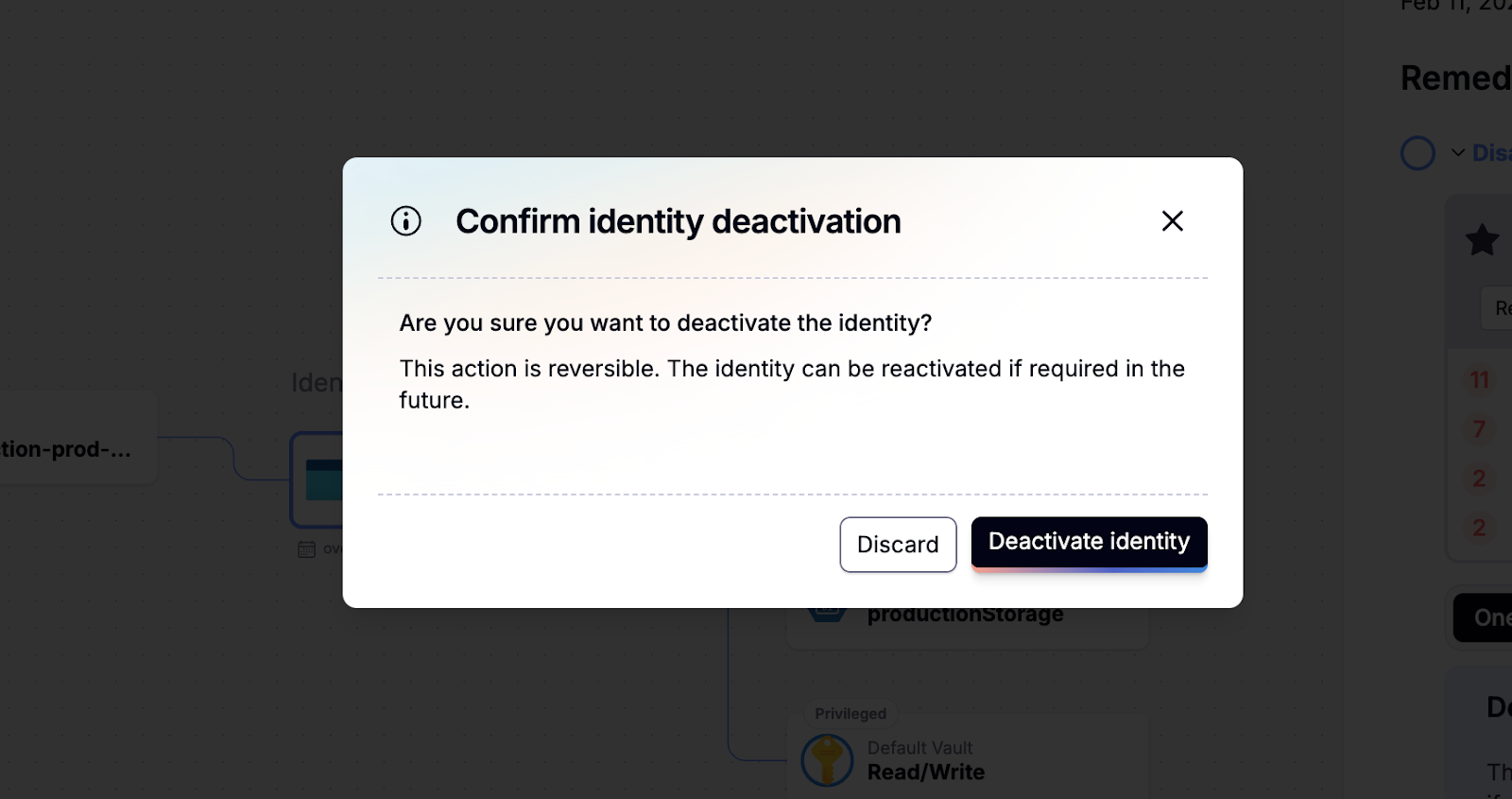
That's how decommissioning becomes a governed process rather than an ad-hoc gamble. And once you can decommission safely, everything else gets easier too: rotation, permission tightening, re-ownership, exception handling. Decommissioning isn't the whole lifecycle. It's the proof that you can finally run one.
Building the data foundation: from gap analysis to intelligent enforcement
Policy intelligence compounds. It doesn’t just surface gaps, it improves the policies themselves.
Traditional access policies are static: written once, based on assumptions, and rarely revisited. Policy intelligence makes them more realistic by grounding them in observed behavior and risk.
Instead of a blanket 90-day rotation requirement, you can implement risk-tiered controls based on what an identity can do and where it operates. A read-only service account in staging doesn’t carry the same risk as an API key with write access to production finance data. Treating them identically under a static rule creates friction without reducing real risk. With policy intelligence, teams can choose the right outcome per identity: approve as-is, right-size permissions, rotate credentials, reassign ownership, or disable and decommission.
This also enables a natural graduation path. Teams can start with gap analysis (identify violations), move to evidence-backed recommendations, and only then progress to automated remediation where confidence thresholds are met. The organizations that reach confident lifecycle enforcement aren’t the ones that jumped from discovery straight to automation—they’re the ones that invested in the intelligence layer that makes enforcement trustworthy.
What this looks like in practice
Without policy intelligence: The team runs a quarterly NHI review. They export a spreadsheet of 12,000 identities. They flag the ones that haven't been used recently. They send a list to engineering teams asking whether each identity can be removed. Engineering, lacking context and fearful of outages, responds slowly or not at all. Three months later, the next review cycle begins with an even longer list. Risk accumulates. Nothing material changes.
With policy intelligence: The team has continuous visibility into which NHIs violate organizational policies—not just which ones are "stale" by an arbitrary definition, but which ones specifically conflict with stated governance requirements. Each violation is enriched with context: who owns the identity, what consumes it, what it accesses, and what the business impact would be if access were modified. High-confidence actions—like disabling an unowned service account with no authentication in 120 days, no active consumers, and a policy mandate for 60-day decommissioning—proceed with minimal friction. Lower-confidence candidates are flagged for human review with the specific context needed to make a decision.
The shift is from periodic, fear-based review cycles to continuous, evidence-based governance.
How to get out of the posture trap (without boiling the ocean)
Don't start with "fix everything." Start with one loop:
Step 1: Pick 3–5 policies that matter in production.
Not the aspirational stuff. The controls you'd defend in an audit and trust in an incident: ownership requirements, rotation expectations, least-privilege rules, vendor access boundaries, "no standing prod" expectations.
Step 2: Measure drift, not just risk.
The goal isn't "find bad things." The goal is: prove where policy and behavior diverge—with enough context to act.
Step 3: Choose one lifecycle action to enforce with confidence.
Not ten. One. Decommissioning is a strong candidate because it reduces attack surface immediately and forces you to build the context you'll reuse everywhere else. (For the operational specifics of decommissioning workflows, our decommissioning guide walks through the process in detail.)
Posture shows you what's wrong. Policy intelligence tells you what to do next.
Discovery is table stakes now. The differentiator isn't whether you can inventory identities. It's whether you can take action continuously, safely, and provably, without slowing the business down. That bridge is policy intelligence. Because the real risk isn't what you can see. It's what you can't change.
If you want to see what policy drift looks like in your environment, and which lifecycle actions you can enforce safely, Oasis can generate a policy gap analysis that prioritizes actions by impact and confidence.
Frequently Asked Questions
NHI policy gap analysis is the practice of systematically comparing an organization's stated access policies (rotation requirements, ownership mandates, least-privilege rules, compliance controls) against the actual state of its non-human identity environment. It answers: does reality match what we said it should be? Unlike generic posture findings, policy gap analysis surfaces specific violations tied to the organization's own governance standards, making findings harder to dismiss and easier to prioritize.
Safe decommissioning requires three pieces of evidence: workload mapping (what depends on the identity), policy alignment (inactivity thresholds and ownership), and blast radius analysis (what happens if it’s modified). Policy intelligence builds this evidence continuously, turning "safe to remove" from a subjective guess into a measurable confidence threshold.
This gap, known as the posture trap, occurs when organizations can see their NHIs but lack the confidence to act on them. Discovery tells you what exists; it doesn’t tell you who is accountable or what will break if you touch it. Policy intelligence closes this gap by adding the behavioral evidence and business context needed to turn a finding into an enforceable decision.
The key is building confidence through a graduated approach. You begin by measuring policy drift (the delta between your standards and reality) to establish behavioral baselines. You then progress from monitoring and flagging violations to providing evidence-based recommendations, and finally to automated enforcement only when specific confidence thresholds are met.
Visibility is stage one. The bridge to true lifecycle management is policy intelligence, the layer that consumes your policies and compares them against observed behavior to make enforcement safe. Organizations that try to leap directly from discovery to enforcement without this middle layer typically stall, because teams lack the confidence to take action at scale. The progression is: discover → measure policy drift → build evidence → enforce with confidence.
We do newsletters, too
Discover tips, technical guides and best practices in our biweekly newsletter.


